

Portable Gas Detection Market to Surpass $4.3 Billion by 2034, Fuelled by Stringent Industrial Safety & Regulatory Frameworks: Research by The Insight Partners
Rising Manufacturing Activities and Regulatory Compliance Drive Growth in Portable Gas Detection Market
New York, NY, April 09, 2026 (GLOBE NEWSWIRE) -- A new comprehensive market research report published by The Insight Partners reveals that the Global Portable Gas Detection Market is projected to grow from US$ 2.2 billion in 2025 to US$ 4.3 billion by 2034, registering a CAGR of 7.7% during the forecast period from 2026 to 2034.
Market Growth Highlights:
- Market Projection: The Global Portable Gas Detection Market is expected to reach US$ 4.3 billion by 2034.
- The US is expected to register a CAGR of 7.1% from 2026 to 2034. The country enjoys a well-developed oil and gas industry, a highly developed chemical industry, and a well-regulated environment, all of which are contributing factors to the sustained need for portable gas detectors.
- The growth of midstream and upstream oil and gas operations presents a positive environment for the utilization of portable gas detectors. Phillips 66 marked a significant milestone in July 2025, as the Dos Picos II Gas Plant started up in the Permian Basin. The plant improves natural gas liquids capture and enhances integrated midstream and export operations. Such large-scale gas handling operations increase the risk of flammable and toxic gases, further emphasizing the need for portable gas detectors.
- Primary Growth Driver: In the European region, hazardous gases include toxic, flammable, and oxygen-deficient gases, which pose risks in industrial facilities, confined spaces, chemical plants, refineries, hotels, and commercial buildings. To avoid accidents, explosions, and health hazards, the European Union has set mandatory safety standards for gas monitoring.
- Equipment installed in hazardous locations must be certified according to ATEX regulations for explosive atmospheres and IECEx regulations for electrical equipment installed in hazardous locations, along with EN, ISO, and OSHA standards, which provide accurate detection, calibration, and real-time monitoring of the gases. Industry-specific regulations, such as EN 378, specify the requirement of gas detection and alarm systems in refrigeration and heat pump installations, especially in hotels and commercial buildings.
- European Union member states, including Germany, France, the UK, and Italy, have implemented their own regulations requiring gas detectors in residential buildings, hotels, and commercial buildings. Companies operating in Saudi Arabia must follow Aramco, SASO, and safety regulations to ensure the safety of their industrial facilities, oil and gas plants, and chemical plants.
- Key Segment: Multi GasType remains dominant and exhibits the highest CAGR (8.5%).
Multi-gas detectors are capable of detecting and measuring several gases at the same time, including combustible gases, oxygen, and toxic gases such as CO and H2S. They are required in complex industrial environments where workers are exposed to risks of several gases at the same time, such as the oil and gas industry, the chemical industry, the wastewater treatment industry, and the firefighting industry.
Multi-gas detectors are required to ensure the safety of workers in these complex industrial environments. With the increasing awareness of industrial safety and the introduction of new technologies such as wireless connectivity and data logging, the demand for multi-gas detectors is increasing. This is because they are versatile detectors that can be used in complex industrial environments.
Download Sample Report:
https://www.theinsightpartners.com/sample/TIPRE00042249
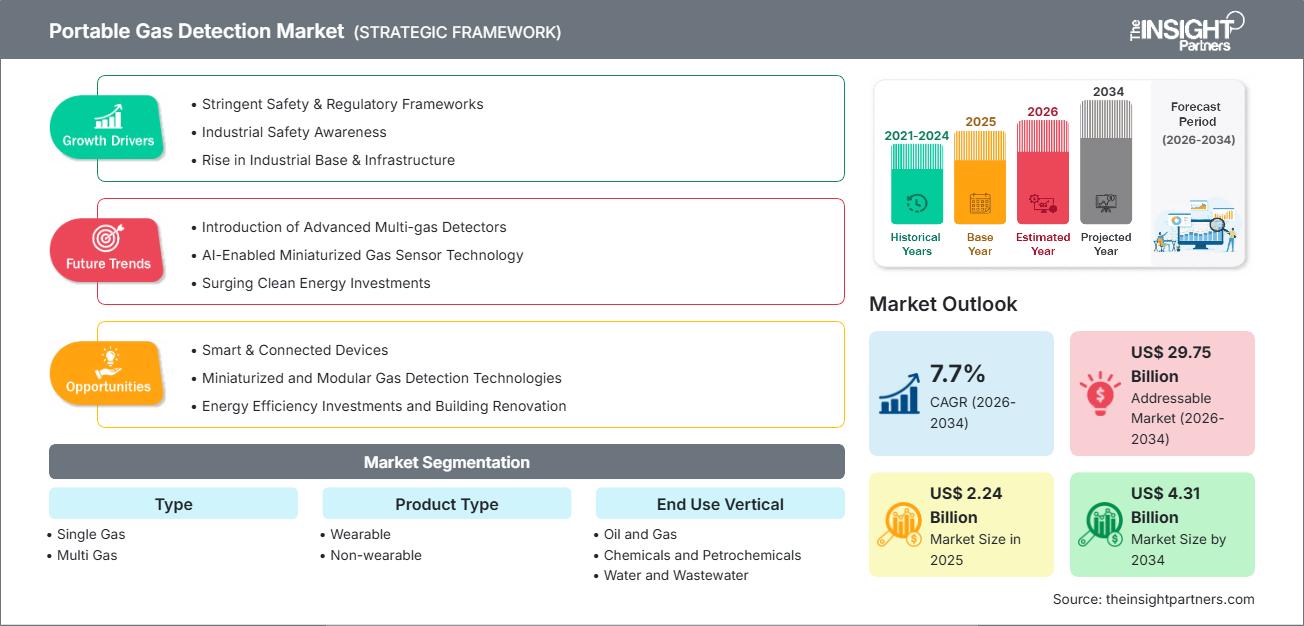
Industrial Safety Awareness:
Industries such as the chemical industry, the oil and gas industry, the energy industry, the manufacturing industry, and the utilities industry are becoming increasingly aware of the risks posed by hazardous gases. Hazardous gases can be classified into three categories: toxic gases, flammable gases, and oxygen-deficient gases.
Gas leaks and industrial accidents can cause severe damage and loss. Industries are becoming more aware of the importance of safety and are taking more and more preventive safety measures. Industries are making more and more use of portable gas detection equipment.
In the European region, various regional and international initiatives are in place. The international community reaffirmed its commitment to improving industrial safety at the 13th Conference of the Parties to the UNECE Convention on the Transboundary Effects of Industrial Accidents (TEIA COP13), which was held in Geneva, Switzerland, in December 2024. The international community reaffirmed its commitment to improving industrial safety at the conference.
The agreement was made with the aim of strengthening the safe management of hazardous substances in the context of the energy transition. The agreement also addresses the emerging risks posed by new technologies and decarbonization processes. The natural hazard management guidelines and the new risk assessment methods support industrial safety awareness.
Major Portable Gas Detection Companies Include:
- Emerson Electric Co
- Honeywell International Inc
- Johnson Controls International Plc
- Dragerwerk AG & Co KGaA
- MSA Safety Inc
- Teledyne Technologies Inc
- Halma plc
- Industrial Scientific Corporation
- RIKEN KEIKI CO., LTD.
- GfG - Gesellschaft für Gerätebau mbH
Portable Gas Detection Market Segmentation Analysis:
5 Gas, Multi-Gas Type Segment to Grow at the Highest CAGR
Five-gas detectors are sophisticated detectors that detect five distinct gases. The gases include combustible gases, oxygen, and three toxic gases. Five-gas detectors are used in environments that have complex conditions. Such environments include oil and gas, chemical plants, mining, and confined spaces.
The main advantage of using five-gas detectors is that they offer comprehensive safety monitoring. This is because they allow users to quickly detect multiple hazards at once. Five-gas detectors have been widely accepted in recent times due to the enforcement of safety regulations in industries. The trend is also attributed to the rise in awareness of hazards in workplaces. Furthermore, there is an increasing demand for versatile portable detectors.
Non-Wearable to Hold the Largest Market Share
Non- wearable gas detectors are devices that are either fixed or portable and are used to detect the concentration of gas in the environment in any industrial or business setup. The devices are usually deployed in industrial and business setups such as refineries, chemical plants, wastewater treatment plants, power plants, storage tanks, and various industrial operations.
The devices are used to detect combustible gases, toxic gases, and oxygen levels. The adoption of the devices is largely driven by the need to meet safety regulations in the workplace and the expansion of various industrial operations. The devices are also crucial in the process industry and in the expansion of operations.
Oil and Gas Segment to Dominate Industry Vertical Adoption
The oil & gas industry is one of the largest segments of portable gas detectors due to the high probability of combustible gases, toxic gases, and oxygen-deficient environments in the exploration, drilling, refining, and storage of crude oil and natural gas. It helps in the real-time detection of gases such as hydrogen sulfide, methane, and carbon monoxide, which are life-threatening to the workforce.
The increasing regulations, safety compliance, and the necessity to avoid explosions in the industry are the key drivers for the growth of the market in this industry. Both single-gas detectors and multiple-gas detectors are useful for the oil & gas industry, as they offer mobility, reliability, and promptness in hazardous environments.
To explore the valuable insights in the Portable Gas Detection Market report, you can easily check a sample PDF of the report – https://www.theinsightpartners.com/sample/TIPRE00042249
North America holds significant share:
The region has an existing industrial base and still maintains a strong demand rate for portable gas detection products, particularly from industries such as oil and gas, chemical, manufacturing, and utility.
In the United States, Occupational Safety and Health Administration (OSHA) standards, which address gas detection in permit-required confined spaces, hazardous waste operations, emergency response, and grain handling facilities, promote the use of gas detection products. The regulations, which are specified under 29 CFR 1910.146, 29 CFR 1910.120, and 29 CFR 1910.272, highlight the importance of continuous gas detection, calibration, and maintenance procedures, thereby increasing the use of portable gas detection products within a standardized approach. Continued regulatory enforcement, industrial expansion, and energy sector investments sustain growth in the North America portable gas detection market.
Portable Gas Detection Market Dynamics:
Driver: Rise in Industrial Base & Infrastructure
The EMEA region has a strong Industrial Ecosystem with a diverse range of industries that are supported by established industrial infrastructure. Industries with the least, but still notable, presence in the EMEA Region include: Manufacturing, Chemicals, Oil and Gas, Utilities, Infrastructure and Mining.
These industries create very complex environments involving hazardous and/or combustible gases and therefore have a large ongoing need for portable gas detection equipment to support their operations, including but not limited to Maintenance, Confined Space Entry, Shut Downs, Mining Operations and Emergency Response Type Scenarios.
In Europe, the push by industry for faster Industrial Modernisation and Sustainability Initiatives has strengthened the existing Safety Requirements.
The introduction of the RESourceEU Action Plan ('Foster Competitiveness'), to be rolled out no later than December 2025, will build on the provisions in the CRMA explains a policy-driven acceleration of mining and processing of raw materials within the EU. The objectives of this initiative include reducing dependence on Geopolitical Regions in relation to mineral extraction; providing Stimulus to Domestic Mining of Lithium, Cobalt and Rare Earths Elements; and increasing the Resilience of Supply Chains for Mining and Mineral Processing - increased requirements for Gas Monitoring by companies engaged in Exploration, Extraction and Mineral Processing.
In continuing with the Middle East's dominant role as the Global Supplier of Hydrocarbons, the continued investment by National Oil Companies (NOCs) and OPEC+ Controlled Production is creating stability for service providers and thereby continuing the demand for Safety Monitoring Equipment.
Opportunity: Rising Smart & Connected Devices
Organizations are seeking intelligent solutions to meet the increasing complexity of industrial operations and the stricter safety regulatory requirements placed upon them. An important factor to consider when adopting new technologies is that more than 50% of confined space fatalities are attributed to either oxygen depletion or toxic gas exposure. Smart and connected gas detection systems provide improved preparedness, accuracy, and compliance by utilizing advanced devices that connect through the Internet of Things (IoT) platform. The application of smart and connected gas detection systems is significant to a broad range of verticals (oil and gas, chemicals, pharmaceuticals, utilities, food, and beverage). It ultimately provides an opportunity to capture higher-priced premium goods.
Challenge: High Initial & Lifecycle Costs
On the other hand, the high cost of acquiring advanced portable gas detectors that are equipped with multi-gas detection, IoT, wireless communication, and AI-based analytics may prove to be a hindrance for small and medium-sized enterprises, as they may not be willing to part with the high cost of acquiring such devices.
Another factor that may affect the adoption of advanced portable gas detectors is the operational costs, as there are additional costs that are associated with the operation of the device. The additional costs include the replacement of sensors, software, and data management, as well as the replacement of the battery, calibration gases, and servicing of the device.
Purchase Full Report (2025–2034 Forecast):
https://www.theinsightpartners.com/buy/TIPRE00042249
Recent Developments:
- In February 2026, Crowcon Detection Instruments announced an expanded partnership with MES Life Safety, a leading provider of technical safety instrumentation, PPE and life safety solutions across North America and Canada. The enhanced relationship extends Crowcon’s national reach, providing customers with improved access to fixed and portable gas detection technologies supported by MES’s coast-to-coast service, rental and sales infrastructure.
- In December 2025, Industrial Scientific, a division of Fortive Corporation, announced it had acquired Aeroqual, a leader in real-time environmental monitoring, headquartered in Auckland, New Zealand. This is a strategic move that accelerates Industrial Scientific’s worker safety vision and bolsters its portfolio of safety sensing technology offerings.
Trending Related Reports:
- Gas Detection Equipment Market Growth, Size, Share, Trends, Key Players Analysis, and Forecast till 2031
- Wireless Gas Detection Market Growth, Trends, and Analysis by 2031
- Gas Detection Equipment Market Growth, Size, Share, Trends, Key Players Analysis, and Forecast till 2031
- Leak Detection Market Analysis, Size, Share, Growth, Trends, and Forecast by 2031
About The Insight Partners
The Insight Partners is a global market research and consulting firm delivering in-depth analysis and actionable insights across technology, media, telecommunications, healthcare, and industrial sectors. The firm supports organizations in identifying growth opportunities, understanding market dynamics, and making informed strategic decisions.
Contact Us:
If you have any queries about this report or if you would like further information, please contact us:
Contact Person: Ankit Mathur
E-mail: sales@theinsightpartners.com
Phone: +1-646-491-9876
Press Release -https://www.theinsightpartners.com/pr/portable-gas-detection-market


Legal Disclaimer:
EIN Presswire provides this news content "as is" without warranty of any kind. We do not accept any responsibility or liability for the accuracy, content, images, videos, licenses, completeness, legality, or reliability of the information contained in this article. If you have any complaints or copyright issues related to this article, kindly contact the author above.
